

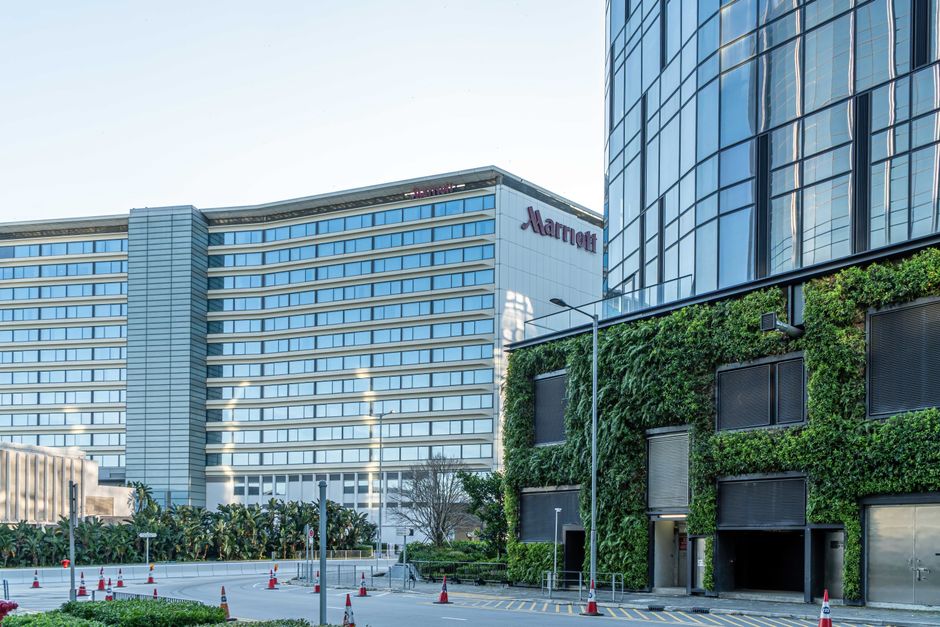
Struggling mainland Chinese real estate developer Shimao Group has taken another major hit as its massive Hong Kong hotel complex was officially sold off by receivers. As Shimao sells Hong Kong hotels, the dual-branded property—which houses both the Sheraton Hong Kong Tung Chung Hotel and the Four Points by Sheraton—fetched HK$2.7 billion, equivalent to roughly US$344 million. The deal highlights the deep financial stress facing Chinese developers as they scramble to appease creditors.
The Anatomy of the Multi-Million Dollar Sale When Shimao Sells Hong Kong Hotels
According to the original report, the purchasing entity behind the acquisition is Oceanfront Hong Kong Limited. The agreement brings a definitive end to months of uncertainty surrounding the massive hospitality asset. Shimao Group formally disclosed the details of the transaction through an official filing submitted to the Hong Kong stock exchange, confirming that the receivers moved forward with the buyer to liquidate the valuable real estate.
A Vital Asset Lost After Failed Attempts
The journey to this sale has been fraught with market challenges. Before the receivers stepped in to take control, Shimao had desperately tried to offload the sprawling property independently. Even after slashing asking prices in an effort to attract hesitant investors, the company failed to secure a viable buyer on its own. Because of these stalled efforts and the developer’s deepening financial distress, the complex was ultimately seized, paving the way for the court-appointed receivers to finalize a deal.
Broader Pressures on Hong Kong Commercial Real Estate
Beyond the immediate troubles of Shimao Group, the transaction reflects wider structural challenges currently facing the Hong Kong commercial real estate market. In recent years, elevated interest rates, a sluggish retail recovery, and dampened tourism spending have severely strained property valuations across the territory. Commercial property owners, particularly those heavily reliant on offshore debt financing, find themselves trapped in a high-cost environment where refinancing options are increasingly scarce. Lenders are taking a much more aggressive stance, stepping in to recover value through court-appointed receivership rather than extending forbearance periods.
This shift in creditor behavior has triggered a wave of distressed asset sales, driving down transaction multiples for prime commercial and hospitality real estate. Analysts tracking the sector note that while liquidity injections from institutional buyers and private equity funds occasionally provide a floor for asset prices, sellers are routinely forced to accept steep discounts. The Tung Chung complex stands out as a prime example of how quickly flagship holdings can change hands when capital markets freeze and debt obligations mature without adequate cash flow to support them.
Impact on the Local Hospitality Sector
Spanning a massive footprint, the Tung Chung complex holds a prominent position within the region’s tourism and lodging infrastructure. As one of the largest accommodations in the entire territory—ranking specifically as the city’s third-largest hotel operation by total room count—the transition of ownership is being closely watched by industry analysts. While the sale injects much-needed capital to address outstanding liabilities, it also underscores the steep discounts and forced liquidations currently characterizing the broader commercial property downturn.
Market watchers are now waiting to see if other mainland developers will be forced into similar liquidations. Whether further high-value assets will face similar fates depends largely on stabilizing market demand and the willingness of international buyers to absorb distressed Asian real estate.
Related reading:
- How a Hong Kong Entrepreneurship Competition Helps Turn Startup Concepts Into Real-World Businesses
- Hong Kong Welcomes Apec Finance Ministers with Pandas and Peak Vistas
- Hong Kong Five Year Plan Policy Address Unveils Strategic Plan to Boost Global Competitiveness
