

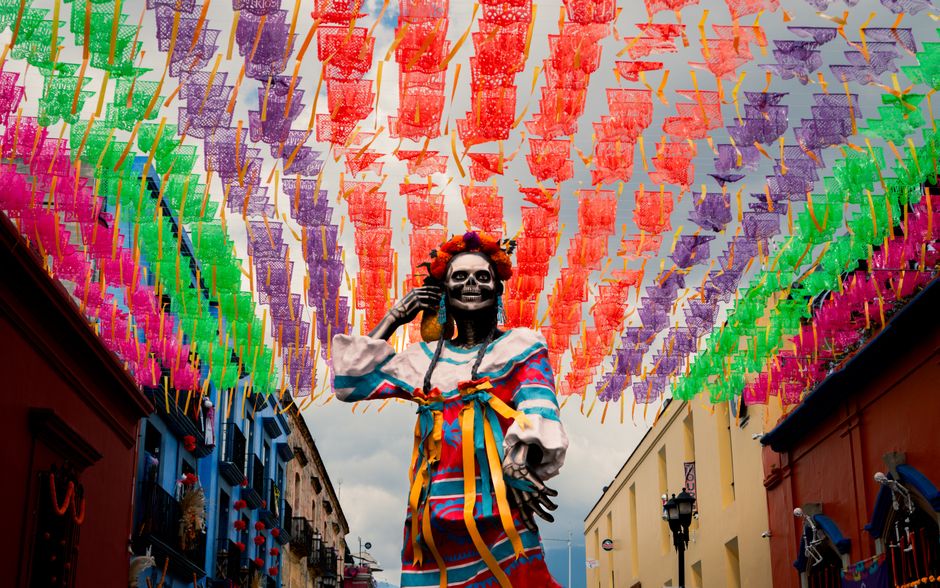
When the vibrant celebrations of the Day of the Dead arrive, cities and towns across Mexico transform into colorful canvases of marigolds, candles, and food offerings. But one of the most visually striking elements of the annual holiday is the delicate, intricately cut tissue-paper banners that sway in the breeze overhead. These iconic decorations are far more than simple party supplies; they are deeply rooted in Mexican tradition, serving as a vital bridge between the living and the departed during one of the year’s most sacred commemorations. For generations, the production of authentic mexico day of the dead papel picado has defined the cultural heartbeat of specialized towns, most notably Huixcolotla in the state of Puebla, widely considered the birthplace of this remarkable folk art.
The Art of Papel Picado and Huixcolotla Heritage
Known locally as papel picado, these colorful garlands are painstakingly crafted to adorn elaborate family altars, festoon residential streets, and decorate public gathering spaces. Each banner features elaborate cut-out patterns—ranging from smiling skeletons and floral motifs to historical symbols—that flutter gracefully with the slightest wind. According to local historians, these banners act as a central pillar in the elaborate altars built to welcome back souls, symbolizing the fleeting nature of life and the gentle sweep of the wind.
In Huixcolotla, the streets practically breathe color during the weeks leading up to November. Artisans sit in open doorways and sunlit courtyards, their fingers moving with a rhythm honed by decades of practice. Master craftsman Don Mateo, a lifelong resident who has been cutting paper since he was eight years old, explains that the process requires immense physical control. “You are not just cutting paper; you are carving stories out of empty space,” he says, pressing a heavy steel chisel into a stack of fifty colorful tissue sheets with a swift strike of his wooden mallet.
Tradition Rooted in Artisan Communities
The creation of these beloved decorations is a labor-intensive craft that sustains specialized communities throughout Mexico. Generations of skilled artisans spend countless hours layering tissue paper, aligning heavy metal chisels, and carefully hammering out intricate designs by hand. What looks like a simple decoration is actually the result of profound generational knowledge and steady artistic precision, keeping ancient cultural practices alive in a rapidly modernizing world.
In neighboring workshops, younger family members learn the craft by observing their parents and grandparents. Doña Carmen, another prominent artisan in the region, notes that the tradition has evolved while maintaining its core integrity. While traditional motifs like skulls, calacas, and dancing skeletons remain the most sought-after designs, contemporary workshops have also begun incorporating custom logos, modern typography, and complex architectural landmarks into their repertoires. Despite these modern adaptations, the fundamental technique remains entirely manual, relying solely on human hands and traditional tools rather than laser cutters or industrial machines.
Global Appeal of a Local Craft
While the garlands remain an indispensable part of local household celebrations and neighborhood festivals, their striking aesthetic has captured global attention. As interest in Mexico’s rich heritage continues to expand worldwide, the demand for authentic, hand-chiseled papel picado has grown exponentially. Export orders now arrive from museums, cultural institutions, and international event planners months ahead of the autumn festivities.
Yet, despite commercial pressures, traditional makers remain committed to preserving the authentic methods that give these paper masterpieces their soulful character. Master artisans like Don Mateo refuse to mass-produce cheap synthetic alternatives, arguing that the ephemeral nature of genuine tissue paper is essential to the spiritual philosophy of the holiday. Ultimately, these paper garlands remind us of the beauty found in temporary art. As the celebrations fade and the tissue paper is eventually swept away, the deep cultural resonance of the craft endures, anchored by the dedicated artisans who keep the tradition breathing year after year.
Related reading:
- Exploring Dubai’s Most Exclusive Dubai Luxury Wedding Venues
- Crafting Your Dream Wedding First Dance Guide: Confidence and Connection
- Silent Hill Townfall review: The Iconic Horror Franchise Is Back From the Dead
