

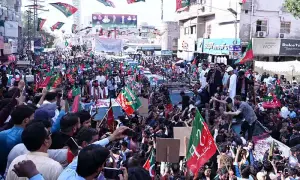
The Islamabad High Court has chosen to establish an expanded bench to review a legal challenge brought against the Pakistan Tehreek-e-Insaf’s upcoming nationwide demonstrations. Judicial authorities are stepping up preparations ahead of the next hearing due to the constitutional sensitivity of the case, a move that highlights the ongoing friction between political agitation and judicial management in the federal capital. At the center of this legal battle is the PTI September 27 protest IHC petition, which seeks to halt the planned demonstrations before they can materialize on the streets.
Origins of the Legal Challenge: The PTI September 27 protest IHC petition
The controversy stems from a petition filed by an Islamabad-based merchant named Waqas Ahmed. Represented by counsel Akhtar Chheena, the petitioner argued that the planned September 27 demonstrations—organized to advocate for constitutional supremacy and demand the freedom of party founder Imran Khan—pose a direct threat to local commerce, public transit, and daily routines in the capital city. The filing of the PTI September 27 protest IHC petition has consequently opened up a broader debate regarding the limitations of political assembly when weighed against public convenience and economic stability in major urban centers.
Concerns Over Capital Disruption and Economic Impact
During the initial hearing presided over by Chief Justice Sardar Muhammad Sarfaraz Dogar, the legal team detailed how the demonstrations could paralyze normal activities. Highlighting that regional leadership intended to spearhead the march directly into Islamabad, the petitioner’s counsel emphasized the severe impact that large-scale street agitation would have on local business owners and residents. Markets often face severe financial losses during major political lockdowns, and the arguments presented in court underscored the fragility of local commerce when major protests are announced without prior consensus or regulated routes. Commercial associations across the city have expressed mounting anxiety over potential supply chain blockages, attendance drops in retail zones, and the general atmosphere of uncertainty that precedes such high-stakes political showdowns. Furthermore, the daily commute for thousands of citizens who rely on open transit corridors between Rawalpindi and Islamabad is routinely disrupted, turning a simple journey across the city into an arduous ordeal. Security measures deployed during these periods also lead to widespread containerization of roads, effectively cutting off neighborhoods and restricting emergency services from operating at their optimal capacity. Business owners argue that while political expression is a fundamental right, it should not come at the direct expense of the livelihoods of ordinary citizens who struggle to keep their shops open in an already challenging economic climate.
Broader Constitutional Questions and Legal Precedents
Beyond local disruptions, the court case touches on wider legal principles. The petitioner’s representative pointed out that multiple active legal matters concerning party figures are already making their way through the judicial system. According to the original report, the legal challenge questions whether utilizing public demonstrations to apply pressure for relief in pending court cases sets a concerning precedent forilis the entire country. Legal experts note that the intersection of street politics and courtroom proceedings creates a delicate balancing act for the judiciary. When political parties mobilize massive crowds to advocate for specific judicial outcomes, it inevitably places immense institutional pressure on judges who are tasked with rendering impartial verdicts based strictly on the law and constitutional frameworks. The ongoing debate surrounding the petition also touches upon the fundamental rights enshrined in the Constitution of Pakistan, particularly the tension between freedom of assembly under Article 16 and the state’s obligation to maintain public order and protect the property of its citizens. As constitutional lawyers weigh in on the matter, the court faces the intricate task of defining where legitimate political dissent ends and public disruption begins, establishing a framework that could influence future political gatherings for years to come.
Next Judicial Steps and Enforcement Measures
In response to the gravity of the petition, the Islamabad High Court has issued official notices to provincial police chiefs across the nation, instructing them to ensure their attendance at the upcoming court proceedings. As the new larger bench prepares to take up the matter, all eyes remain fixed on how the judiciary will balance the right to political assembly with the protection of public order. Law enforcement agencies are simultaneously reviewing their own contingency plans to manage potential crowd control scenarios, ensuring that adequate personnel and preventive measures are deployed across critical entry and exit points of the capital. The upcoming sessions will likely require detailed submissions from both the federal government and the political party’s legal representatives, providing a comprehensive platform to address security concerns, route permissions, and the overarching legal validity of the demonstrations.
With preparations for the nationwide demonstrations moving forward, the upcoming hearings are expected to shed more light on the legal boundaries governing political protests and public safety in the federal capital. As the judiciary deliberates on the nuances of the case, the broader political landscape of Pakistan watches closely to see how the ruling will shape the future dynamics between the state and opposition movements.
Related reading:
- Islamabad High Court Rules Against Isolation for Imran Khan and Bushra Bibi in Adiala Jail in Landmark Imran Khan Adiala Jail isolation ruling
- Justice Raheel Kamran Sheikh Resigns from Lahore High Court to Focus on Legal Scholarship
- Justice Raheel Kamran resigns: Lahore High Court Judge Steps Down

3 comments
[…] PTI September 27 protest IHC petition: Islamabad High Court Sets Up Larger Bench […]
[…] PTI September 27 protest IHC petition: Islamabad High Court Sets Up Larger Bench […]
[…] In response to the preliminary arguments presented by the provincial legal team, the presiding judge opted to extend the timeline for review. The court officially adjourned the hearing, pushing further arguments and the formal decision on the jurisdictional objection to September 14, giving both sides additional time to submit comprehensive legal briefs. For more background on how these court benches are formed, readers can check out reports on the extended judicial benches. […]