

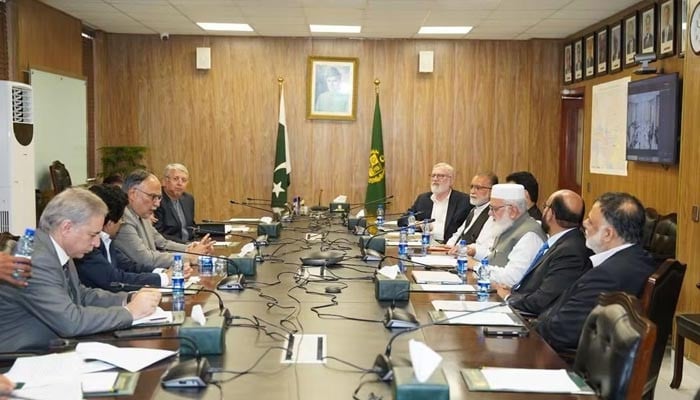
Islamabad saw rising political tensions over energy costs as government officials sat down with a delegation from Jamaat-e-Islami (JI) to address mounting public frustration over petroleum levies. The talks follow widespread demonstrations organized by the political party, which has strongly criticized the administration’s current pricing framework and taxation on daily energy necessities. As households and businesses grapple with historic inflation, the administration faces mounting pressure to reevaluate its fiscal policies. The debate over how much tax should be levied on imported petroleum products has dominated local news headlines for months, drawing widespread attention from economists, trade unions, and ordinary citizens alike.
Government and JI Officials Meet in Islamabad to Discuss JI fuel levy proposals government
Federal Minister for Planning, Development, and Special Initiatives Ahsan Iqbal spearheaded the government’s negotiation team, holding formal discussions with representatives from Jamaat-e-Islami. The core of the agenda centered around the petroleum levy and the compounding impact of soaring fuel prices on everyday citizens. While the administration maintained that solutions must remain fiscally responsible, both sides acknowledged the urgency of addressing the financial pressure currently facing households and businesses across the country. Government representatives outlined the constraints imposed by international financial agreements, while JI delegates emphasized that the current tax burden is simply unsustainable for the average wage earner.
Furthermore, energy sector experts have pointed out that indirect taxation on fuel cascades through the entire economy, driving up the cost of food transportation, manufacturing, and basic utility services. This systemic effect has made energy affordability a primary grievance for the public. Economists note that while the state relies heavily on petroleum levies to meet revenue targets set by international lenders, the social cost of these measures is reaching a tipping point, necessitating compromises between political stakeholders.
Six-Point Proposal Submitted
During the negotiating session, the JI delegation officially handed over a comprehensive set of six distinct recommendations aimed at bringing immediate relief to the public. According to the original report, these proposals focus heavily on restructuring petroleum taxation and easing the heavy burden that high energy rates place on the working class. The party’s leadership insists that these measures are both realistic and workable if the administration chooses to prioritize citizen welfare.
The six points specifically target the removal of extra surcharges, a reduction in general sales tax on petroleum derivatives, and a freeze on power sector adjustments that compound the misery of high pump prices. JI leadership argues that cutting these levies would not necessarily bankrupt the national treasury if the government simultaneously curtails non-development expenditures and luxury spending within the public sector. Public policy analysts are currently reviewing the viability of these demands to see if a middle ground can be reached.
Demonstrations Will Move Forward Despite Dialogue
Even as diplomatic efforts and formal talks continue between the two factions, Jamaat-e-Islami has made it clear that their planned agitation campaign will not be paused. Party representatives stressed that street protests and public demonstrations will proceed concurrently with the negotiations. Organizers argue that maintaining pressure on the administration is vital to ensure that the submitted proposals are taken seriously and implemented without unnecessary delays.
The decision to keep the protest movement active reflects a deep-seated distrust among opposition parties regarding bureaucratic delays and broken promises from past administrations. By coupling formal table negotiations with grassroots mobilization, JI hopes to keep the momentum alive. Local authorities across major urban centers remain on high alert, preparing for potential traffic disruptions and large gatherings while hoping that ongoing talks will eventually yield a peaceful and permanent resolution.
Next Steps and Outlook
As the government evaluates the newly submitted six-point plan, including the detailed framework, the coming days will likely determine whether compromise is possible between the two sides. With public dissatisfaction remaining high over cost-of-living concerns, the administration faces a delicate balancing act between maintaining economic stability and responding to grassroots political pressure.
The ultimate outcome of these negotiations could set a precedent for how future economic grievances are handled in the country. If the government accommodates some of these demands, it may signal a shift toward more flexible fiscal policymaking. Conversely, a complete rejection of the proposals could trigger a broader wave of civil unrest, further complicating an already challenging economic landscape.
Related reading:
- Martin Romualdez plunder charges Philippines: High-Stakes Flood Control Scandal Shakes Government
- When Does Government Listen to Protesters?
- Azad Jammu and Kashmir Prime Minister Assigns AJK Government Cabinet Portfolios
